A tapping defect is usually the combined result of tool, hole, material and setup. Change one variable at a time and preserve the failed part and tool as evidence.
High or rising torque
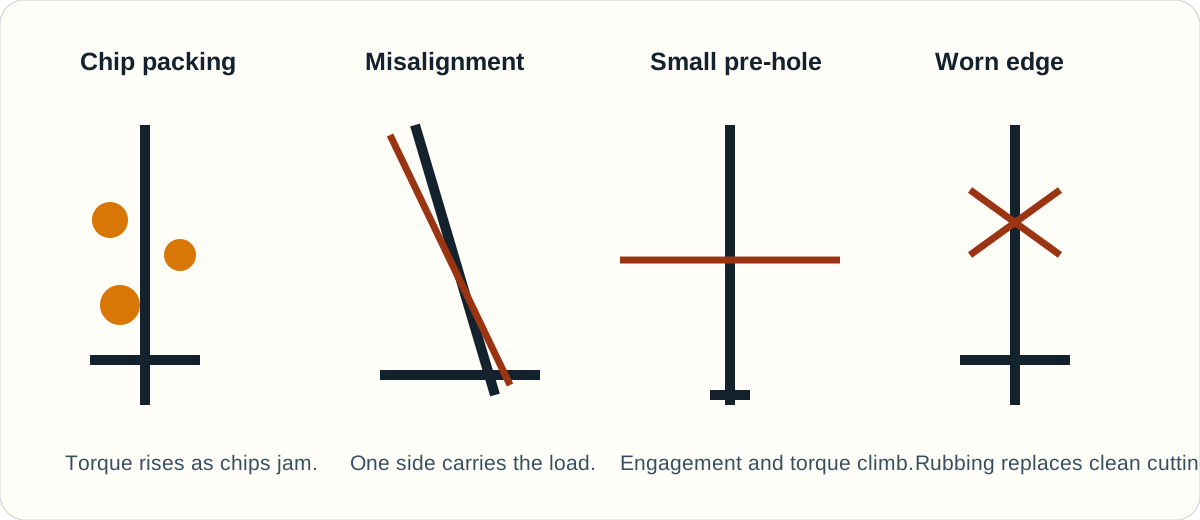
Measure the pre-hole and confirm it is appropriate for cutting or forming. Inspect for worn teeth, material pickup, inadequate lubricant, misalignment, chip packing and bottom contact.
Do not solve high torque by enlarging the hole without engineering review. That can trade a breakage symptom for insufficient thread material.
Oversize or loose threads
Check tap runout, holder float, incorrect class, chipped teeth and double cutting caused by unstable guidance. Confirm that the correct gauge is clean and within calibration.
A large pre-hole changes engagement but does not by itself fully define pitch diameter. Review the complete cutting motion and tap geometry.
Undersize or tight threads
Look for incorrect tap class, springback in the material, a worn tap, inadequate cutting action or debris left in the thread. Clean before gauging and compare results at several depths.
Confirm that plating or coating allowance was included in the controlled process if gauging occurs before finishing.
Rough finish and torn flanks
Inspect edge condition, lubrication, speed, alignment and chip recutting. Gummy materials can build up on an edge, while work-hardening alloys can deteriorate when the tool rubs.
Match the exact tap geometry and coating to the material group, then run a documented trial rather than polishing away evidence from the failed thread.
Chip packing in blind holes
Verify flute direction, chip space and programmed depth. The drill point, tap chamfer, chips and trapped lubricant all occupy volume below the usable thread.
Use the maker-approved chip-control method. Repeated manual reversal is not a universal cure and can wedge chips against cutting edges.
Broken tap response
Stop and make the machine safe before approaching sharp chips or fragments. Determine whether approved removal can preserve the part without damaging the hole or creating a safety hazard.
Document the location and fracture appearance, inspect preceding parts, and correct the root cause before restarting. A replacement tap is not a corrective action by itself.
Never continue driving a tap after an unexplained torque spike. A broken hardened tool can create sharp fragments and a difficult, costly recovery.
Technical references
- Tap Drill Sizes and Technical Formulas — Guhring, Inc.. Accessed 2026-11-10.
Standards references identify scope and terminology; protected dimensional tables are not reproduced.