Depth planning must distinguish total drilled depth, full-diameter cylindrical depth, tap travel and full usable thread. The conical drill point and incomplete tap lead do not produce full threads.
Plan the stack of depths
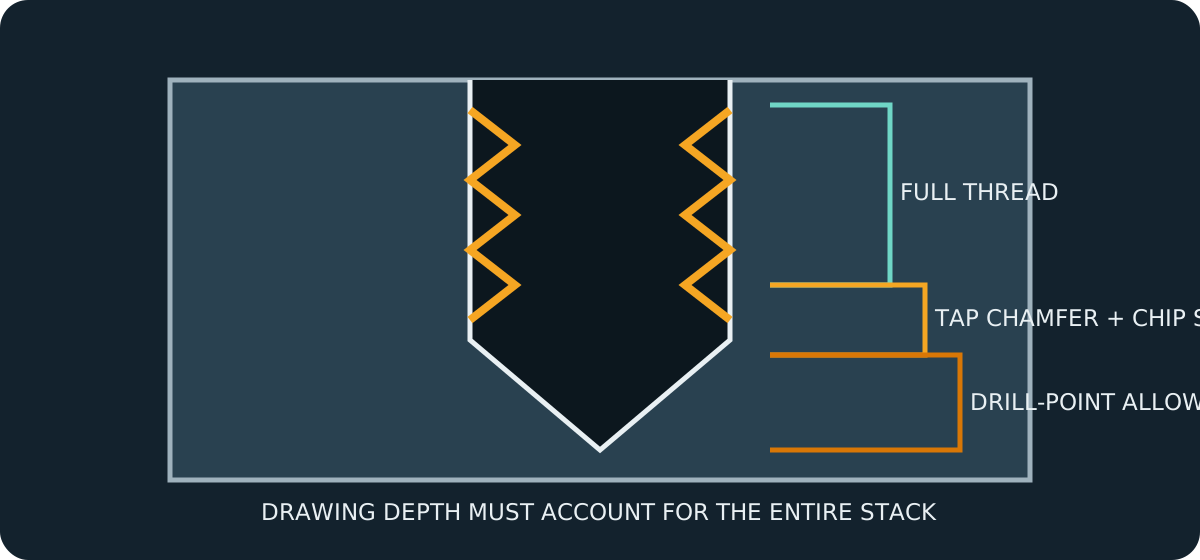
Start from required full-thread depth, then add the tap’s lead length, safe bottom clearance and the drill-point allowance. Obtain exact values from the selected drill and tap geometry.
Choose a chip strategy
A suitable spiral-point tap can push chips ahead through a through hole. Blind holes often use geometry that carries chips back toward the entry, but the tool maker’s material guidance controls.
Verify before production
Check that the tap cannot strike the bottom at programmed depth and that chips have somewhere to go. Sectioning or other process validation may be appropriate when usable depth is critical.
Calculate usable depth
Usable full thread begins only after the tap chamfer has completed the profile. Total drilled depth also includes the conical drill point and a bottom margin, so it must exceed the specified full-thread depth.
Use the selected drill point angle and the tap maker's chamfer data for exact planning. Generic extra-depth rules can be unsafe when wall thickness or a hidden feature is close.
Manage chips by hole type
A through hole may allow a spiral-point tap to push chips ahead and out. Confirm that there is clearance beyond the part and that expelled chips cannot damage equipment or personnel.
A blind hole needs a strategy that carries chips toward the entrance or provides controlled clearing. Chip volume and lubricant trapped at the bottom also consume space.
Set and verify the stop
Establish tap length compensation, holder behavior and machine position from measured tools. Dry-run or single-block the setup when collision or bottom contact is possible.
Inspect first-piece full-thread depth with the specified method. Counting visible turns at the entrance does not prove that the lower portion is complete.
Bottom contact can break the tap or damage the machine. Program depth from controlled tool geometry and setup measurements.