A smaller hole increases thread engagement and tapping torque. A larger hole reduces torque but also reduces thread material. The best balance depends on the application.
Decision sequence
Identify thread family, nominal diameter, pitch/TPI and required class. Then identify whether the tool cuts or forms, the work material and the manufacturer’s stated drill range.
- Do not mix cut and forming values.
- Do not extend straight-thread formulas to pipe threads.
- Account for hole production and coating.
- Run a controlled test when the process matters.
Use the approximation honestly
Nominal diameter minus one pitch is a convenient cut-tap estimate for common 60-degree threads. It is not an official value and does not model every tolerance or material effect.
Start from the tap, not a percentage
Identify the complete thread, cutting or forming process, work material and tap model. A manufacturer chart for that combination is the primary starting point; a diameter-minus-pitch formula is only a cross-check for conventional cutting taps.
Higher theoretical engagement is not automatically better. A smaller hole raises cutting load and torque, often with little useful increase in joint capacity.
Account for the produced hole
Drill designation is not the finished-hole measurement. Runout, point grind, wear, feed and material can enlarge or distort the hole, so validate the process with suitable hole metrology.
If a recommended number or letter drill is unavailable, compare nearby diameters explicitly. Record whether the substitute is larger or smaller and obtain approval when the drawing or controlled process does not permit substitution.
Worked selection example
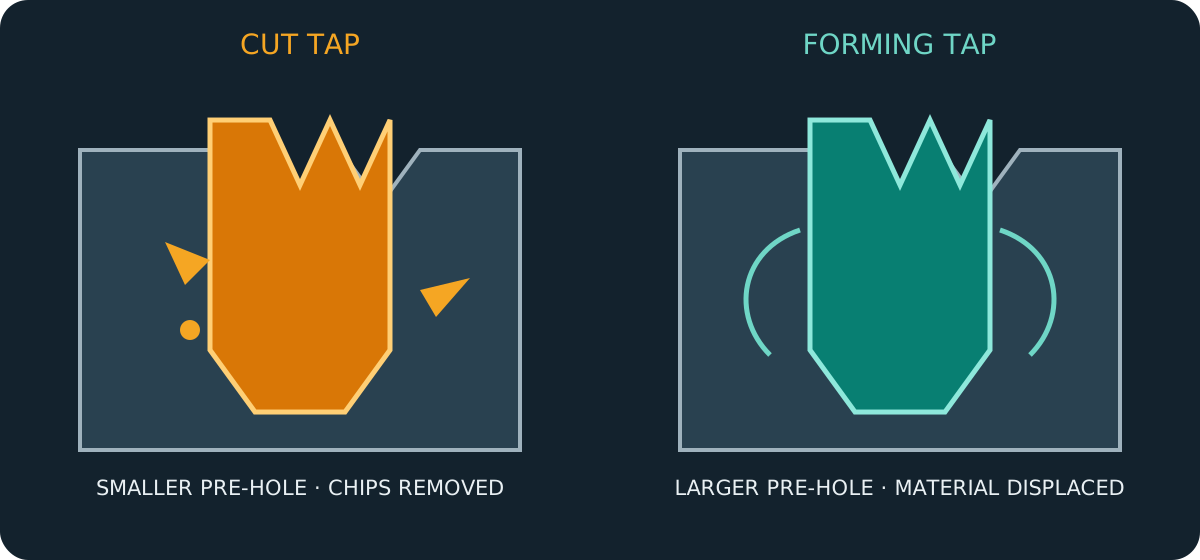
For a 1/4-20 UNC cutting tap, the simple estimate is 0.2500 minus 1/20, or 0.2000 inch. The reviewed maker lookup selects a #7 drill at 0.2010 inch; the lookup result, not the rounded estimate, is the recommendation.
For a forming tap of the same designation, do not reuse #7. Select the maker's material-specific pre-hole range and verify it through torque and finished-thread gauging.
For safety-critical or production work, the controlled process plan and inspection requirement take precedence over a general chart.
Technical references
- Cle-Line C01112 Tap and Drill Recommendations — Greenfield Industries / Cle-Line. Accessed 2026-11-09.
- Guide to Tap Drill Sizes — Forming Taps, UNC — OSG Europe Logistics. Accessed 2026-11-10.
Standards references identify scope and terminology; protected dimensional tables are not reproduced.