The processes are not interchangeable in a calculator. ThreadSizeGuide returns a forming result only when a source-specific pre-hole range exists for that thread.
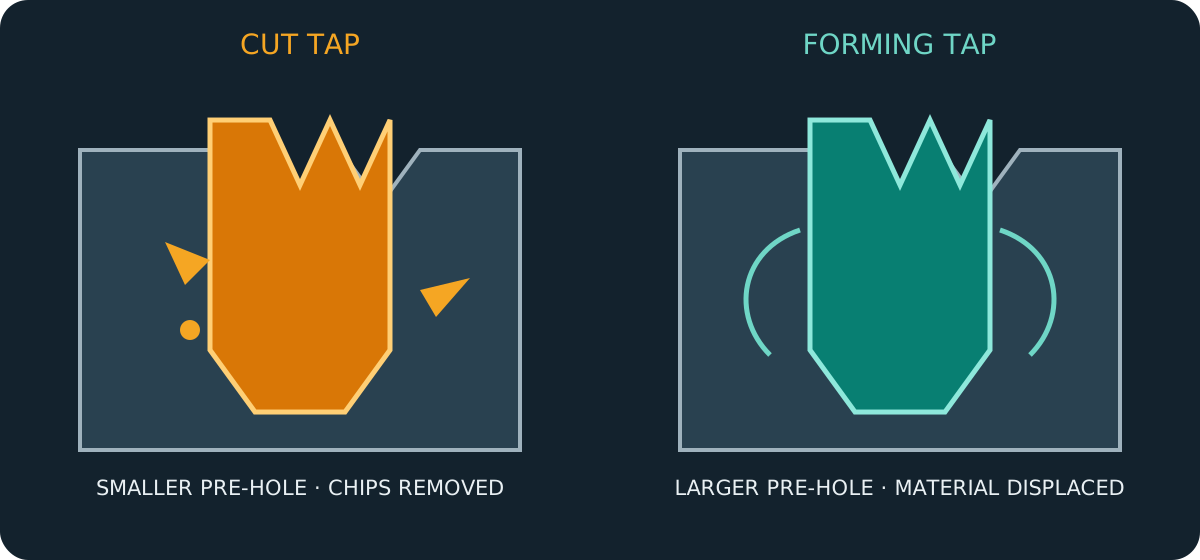
Cut tapping
Cut taps can work across a broad range of machinable materials, but chip direction and evacuation must match the hole. The source-backed cut-tap values are manufacturer recommendations for general reference.
Form tapping
Form taps need suitable ductility, lubrication and pre-hole control. An undersized hole can drive torque sharply higher; an oversized hole can reduce formed thread material. Use the exact tap maker’s chart and material guidance.
How each process creates the thread
A cutting tap shears material into chips. A forming tap uses lobes to plastically displace suitable material into the thread profile, so it produces no cutting chips but creates different friction and material-flow demands.
Because material must flow, forming requires a larger and more tightly controlled pre-hole. Using a cutting-tap drill with a form tap can cause excessive torque or tool failure.
Material and lubrication limits
Forming is generally limited to sufficiently ductile materials and the approved hardness range. Brittle or poorly formable materials can crack or fail to fill the profile.
Lubrication is critical because the process relies on high-pressure sliding contact. Use the tap maker's approved lubricant, speed and pre-hole range for the exact material.
Validate before changing process
A switch from cutting to forming is a process change, not a tool substitution. Review hole size, torque capacity, lubricant, material certification, gauging and any design restrictions.
Run a documented trial and inspect the thread with the required gauge. For critical work, confirm that the resulting grain flow and surface condition meet the engineering requirement.
Never use the cut-tap drill simply because the thread designation matches. Treat the process as a separate setup.
Technical references
- Guide to Tap Drill Sizes — Forming Taps, UNC — OSG Europe Logistics. Accessed 2026-11-10.
- A-XPF Highly Efficient Multi-Purpose Forming Tap — OSG Canada. Accessed 2026-11-10.
Standards references identify scope and terminology; protected dimensional tables are not reproduced.