Series selection is an engineering decision. Coarse threads usually offer more space between flanks and can be more tolerant of damage; fine threads provide more turns per unit length and a larger minor diameter for the same nominal size.
Identification
Measure nominal diameter and TPI, then confirm the series. A fastener can enter a wrong-pitch nut briefly, so hand engagement is not a valid inspection method.
- Use a pitch gauge without forcing it.
- Compare several full thread intervals.
- Confirm the drawing and class.
Machining differences
Different pitch means different tap geometry and a different cut-tap pre-hole recommendation. Fine threads also create more turns over the same depth, which affects chip control and tapping time.
Selection tradeoffs
Material, joint geometry, adjustment needs, environment and established product standards all matter. Avoid a universal claim that one series is always stronger or better.
Geometry at the same diameter
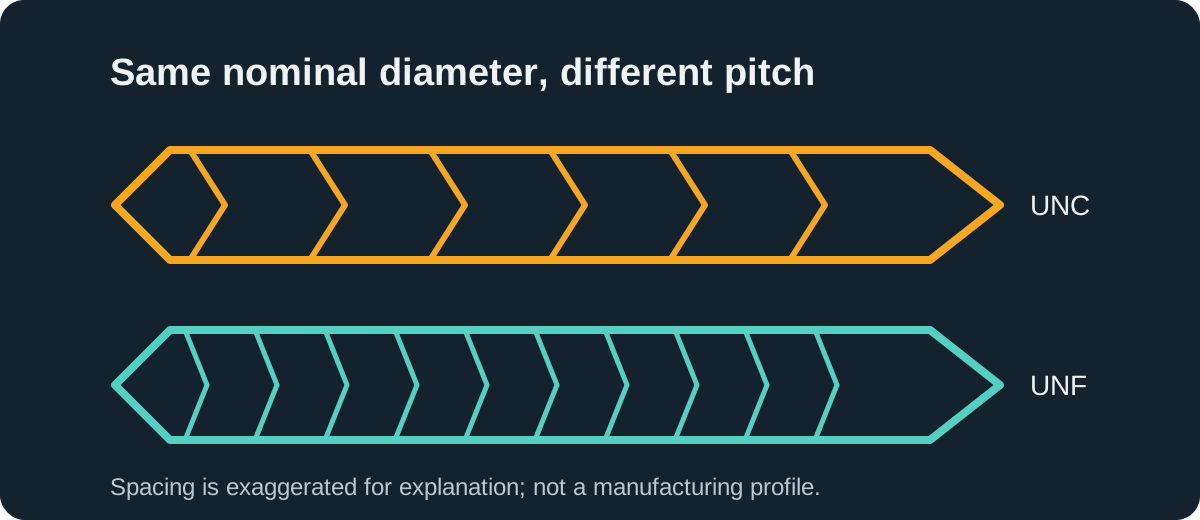
At 1/4 inch nominal diameter, UNC is 20 TPI and UNF is 28 TPI. The fine series therefore has a shorter axial pitch and a larger basic minor-diameter tendency, while the external major diameter remains nominally the same.
These geometric differences change tap drills, tooling, turns of engagement and sensitivity to dirt or damage. They do not make either series universally superior.
Choose by joint requirements
Coarse threads are commonly favored where rapid assembly, generous flank spacing or tolerance of surface damage matters. Fine threads can support finer adjustment and more turns in a limited length.
Strength depends on fastener grade, materials, engaged length, preload, geometry and failure mode. Use the joint design authority and applicable product standard rather than a coarse-versus-fine slogan.
Prevent wrong-series assembly
Mark bins and setup sheets with the full diameter-TPI callout. Verify questionable hardware with a pitch gauge and diameter measurement instead of testing it in a nut.
A wrong pitch may enter one or two turns and then bind. Stop immediately; forcing it can damage both internal and external threads while creating a misleading impression of tightness.
Never substitute UNC and UNF fasteners solely because nominal diameter matches.
Technical references
- ASME B1.1-2024 Unified Inch Screw Threads — ASME. Accessed 2026-11-10.
Standards references identify scope and terminology; protected dimensional tables are not reproduced.