The drill package gives nominal diameter. Actual hole geometry also reflects tool condition, point grind, holder, spindle, fixturing, feed, material and breakthrough behavior.
Where runout comes from
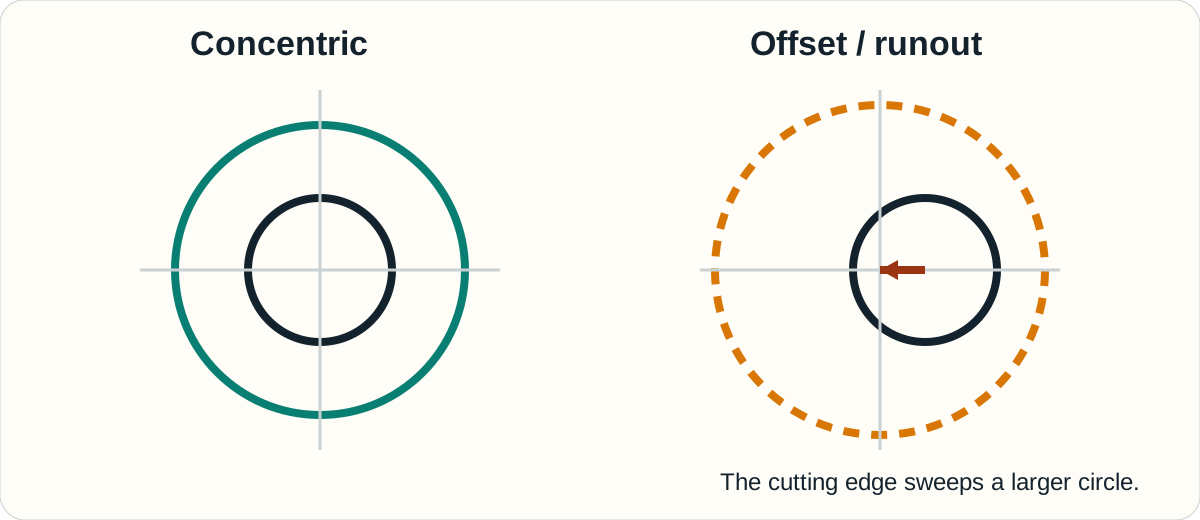
Debris on mating surfaces, damaged shanks, worn collets, spindle error and excessive tool overhang can all contribute. A good component cannot compensate for a poor assembled stack.
Why tapping notices
An oversized or lobed pre-hole changes thread material and can make gauging inconsistent. A drill that wanders or work-hardens the wall can also raise tapping risk even when its nominal diameter is correct.
A controlled check
Clean and assemble the holder, indicate close to the cutting end, then drill a representative test piece and measure the hole with a suitable method. Track the result as the tool wears.
Measure the assembled stack
Runout can originate at the spindle, holder, collet, shank or tool. Indicate the assembled drill near the cutting end after cleaning all mating surfaces; checking one component alone can miss the combined error.
Minimize unsupported length while preserving safe clearance. Excessive overhang magnifies deflection and makes a sound tool behave poorly.
Connect runout to tap performance
A larger or lobed pre-hole reduces thread material and can make gauge results inconsistent. Runout can also worsen wall finish or encourage wandering, producing local conditions that raise tap load.
Measure representative holes with metrology appropriate to their diameter and tolerance. A caliper reading across an entrance cannot describe taper, lobing or the bottom of a blind hole.
Troubleshoot in order
Clean and reassemble first, then check holder condition, shank damage, spindle error, point symmetry, workholding and feed. Change one factor at a time so the correction remains attributable.
Record runout and hole results for new and worn tools. The trend can reveal holder degradation or a tool-life limit before thread quality fails.
A caliper is often inadequate for tolerance-critical small holes; select metrology appropriate to size and required uncertainty.
Technical references
- Technical — Drill Hole Qualities — Guhring, Inc.. Accessed 2026-11-10.
- Tap Drill Sizes and Technical Formulas — Guhring, Inc.. Accessed 2026-11-10.
Standards references identify scope and terminology; protected dimensional tables are not reproduced.